I am bound by confidentiality obligations to protect Oracle’s confidential information, proprietary systems, and customer data.
The following is a selection of publicly available, generally released (GA) products and features that I have contributed to.
These examples represent a subset of my work and are intended to demonstrate my role in designing AI-powered healthcare platforms, enterprise workflows, and large-scale data systems.
At Oracle Health, I operate as a Principal Product Designer focused on embedding AI, data, and intelligent workflows directly into clinical and operational environments. My work centers on translating complex healthcare systems into usable, scalable product experiences that improve decision-making, efficiency, and patient outcomes.
Status: Generally Available (GA)
Oracle Population AI Assistant
Problem
Population health insights often exist outside of clinician workflows, requiring providers to leave their EHR, navigate multiple systems, and manually synthesize patient data. This creates friction, increases cognitive load, and contributes to physician burnout, while limiting the ability for health systems and payers to deliver timely, actionable insights at the point of care. At a system level, Oracle relied on third-party integrations to surface these insights, creating cost, dependency, and limitations in how experiences could evolve.
How might we design a last-mile, EHR-agnostic solution that embeds population health intelligence directly into clinician workflows while establishing a platform Oracle fully owns?
Contribution
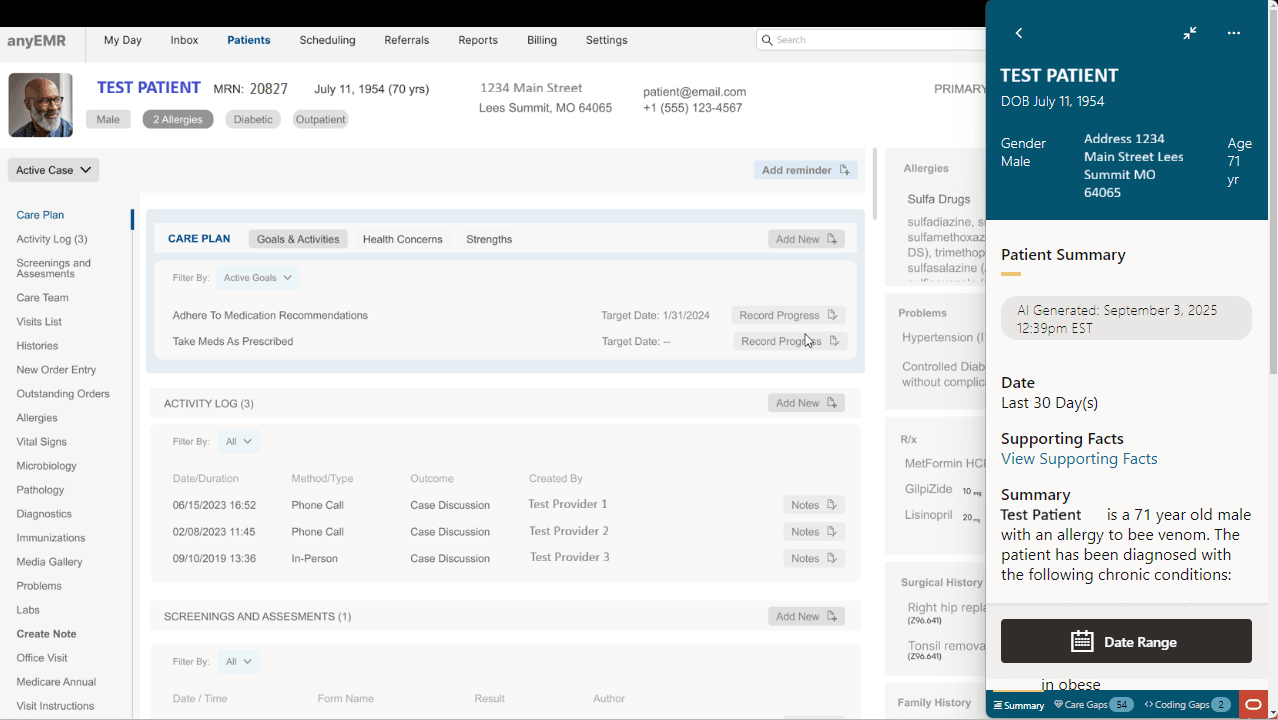
Led UX design for a net-new, EHR-agnostic integration platform that embeds AI-powered population health insights directly within third-party EMR workflows. Defined the interaction model for an “agentic companion” experience that operates alongside any EHR via a contextual sidebar, enabling clinicians and care teams to access insights without leaving their workflow.
Key areas of ownership included:
● Designing end-to-end workflows for embedding population health data into point-of-care experiences
● Integrating LLM-generated patient summaries, care gaps, HCC coding insights, and longitudinal patient context
● Establishing scalable UX patterns for cross-EHR interoperability and last-mile data delivery
● Partnering with product, engineering, and platform teams (ODA, RPA) to align UX with a new underlying integration architecture
● Driving Redwood design system alignment across a net-new platform experience Impact
Impact
● Established a new, Oracle-owned last-mile integration platform, reducing reliance on third-party solutions
● Enabled population health insights to be delivered directly within clinician workflows across non-Millennium EHRs
● Reduced clinician friction by minimizing navigation outside the EHR and supporting faster decision-making
● Increased perceived value of Oracle’s population health products by embedding intelligence at the point of care
● Created a scalable foundation for future AI-driven, agent-based healthcare experiences

Status: Publicly Announced / In Market
Oracle Life Sciences AI Data Platform
Problem
Healthcare and life sciences organizations rely on fragmented data ecosystems spanning EHRs, claims, labs, genomics, and clinical trials. Analysts and researchers often spend 60–70% of their time preparing and transforming data, slowing research, increasing compliance risk, and limiting the ability to generate timely insights.
How might we unify data and embed AI-driven analysis into a single platform that accelerates research, supports governance, and enables scalable, reproducible workflows?
Contribution
Led UX definition for the North Star experience of Oracle’s next-generation AI Data Platform across Health and Life Sciences.Defined future-state workflows for a unified, AI-powered research environment, including:
● AI-assisted cohort building and data exploration
● Agent-driven analysis and hypothesis generation
● Governed, traceable workflows with full data lineage
● Reusable research artifacts and cross-team collaboration
● Low-code creation of AI agents within platform constraints
Synthesized complex requirements across researchers, data analysts, scientists, engineers, and clinical informaticists into a scalable platform vision. Partnered closely with product, engineering, and leadership to align the experience with Oracle Redwood standards, governance requirements, and a P0 strategic roadmap.
Impact
● Established the UX foundation for a P0 strategic Oracle initiative within the Health and Life Sciences portfolio
● Defined experience patterns enabling up to 60% faster time-to-first dataset and 50% faster analysis cycles
● Introduced a framework for governed, reusable, and traceable research workflows supporting compliance and reproducibility
● Enabled a unified, AI-powered research experience across previously fragmented data ecosystems
● Positioned Oracle’s platform vision against legacy analytics systems with an integrated, agent-driven approach

Status: Generally Available (GA)
Oracle HDI Check-In Prep
Problem
Care managers often review up to 22 sections of a patient record and spend as much as 30 minutes preparing for a single patient interaction. This process is manual, time-consuming, and cognitively demanding, reducing the time available for direct patient engagement and increasing the risk of missing important clinical or social insights. At a system level, care preparation workflows were not designed to support efficient synthesis of longitudinal patient data across multiple sources.
How might we use AI to transform fragmented patient data into clear, actionable summaries that support faster, more consistent care preparation?
Contribution
I led UX design for a first-of-its-kind LLM-powered patient summarization experience embedded within Oracle Health’s Care Management workflows. Defined end-to-end interaction patterns for generating, reviewing, and validating AI-powered patient summaries, including:
● Summarization of longitudinal patient records across multiple data sources
● Surfacing supporting clinical evidence alongside generated insights
● Enabling human-in-the-loop validation and feedback
● Allowing users to adjust timeframes and refine summary scope
Designed within critical real-world constraints, including sub-1-minute latency, read-only validation requirements, and the need to establish trust in AI-generated content. Collaborated closely with product, engineering, and clinical stakeholders to ensure the experience aligned with care workflows, technical feasibility, and regulatory expectations.
Impact
● Reduced chart review time from up to 30 minutes to under 10 minutes per patient
● Enabled care managers to prepare more efficiently and spend more time engaging with patients
● Decreased cognitive load and risk of missing important patient information
● Established a scalable UX pattern for integrating AI-generated summaries with supporting evidence and feedback loops
● Launched as a beta GenAI feature within an accelerated timeline, contributing to early adoption of AI workflows within Oracle Health
● Expanded across Oracle Health Data Intelligence AI applications as a foundational pattern for AI-assisted clinical workflows
I'm always open to friendly emails!
adangerdesigner(at)gmail.com
